India’s mutual fund industry has grown nearly six-fold over the past decade, with Assets Under Management (AUM) reaching ₹87.08 lakh crore as of August 31, 2026, compared with ₹15.63 lakh crore in August 2016. This rapid expansion has also created a growing opportunity for Mutual Fund Distributors (MFDs) to build businesses around investor servicing, client relationships and long-term AUM growth. But becoming an MFD is only the starting point. If you are considering building a Mutual Fund Distribution Business in India, this guide explains what the journey involves, from eligibility and NISM certification to obtaining an ARN, choosing your distribution setup and building a business that can scale over time.
If you are considering starting a Mutual Fund Distribution Business in India, there is more to the journey than obtaining an ARN. You need to meet the eligibility requirements, complete the necessary certification, register with AMFI, get empanelled with AMCs or a suitable MFD platform, and build the systems and client relationships needed to grow your business.
This guide covers the process of becoming an MFD and the key considerations involved in building a Mutual Fund Distribution Business.
What Is a Mutual Fund Distribution Business?
A Mutual Fund Distribution Business involves helping investors access and transact in mutual fund schemes while providing ongoing support and service.
A Mutual Fund Distributor distributes mutual fund schemes under the Regular Plan structure and receives distribution-related commission from the mutual fund industry. This is different from a Registered Investment Adviser (RIA), who operates under a separate regulatory framework and charges clients directly for investment advice.
For an MFD, the business goes beyond facilitating transactions. Building long-term client relationships, supporting investors, acquiring new clients and steadily growing AUM are important parts of developing the business.
Who Can Become a Mutual Fund Distributor?
The eligibility requirements for becoming an MFD are relatively straightforward. You generally need to meet the following requirements:
-
Minimum age: You must be at least 18 years old.
-
PAN: A valid PAN is required.
-
Aadhaar: Aadhaar is required for the applicable registration and verification process.
-
NISM certification: You need to pass the NISM-Series-V-A: Mutual Fund Distributors Certification Examination.
-
AMFI registration: After completing the certification requirement, you need to apply for an AMFI Registration Number (ARN).
-
KYD requirements: You need to complete the applicable Know Your Distributor (KYD) requirements.
-
No specific finance degree required: You do not necessarily need a finance degree or previous experience in the mutual fund industry to enter the profession, subject to the applicable regulatory requirements.
Professionals from different backgrounds, including salaried professionals, entrepreneurs, homemakers, retirees and graduates, can explore mutual fund distribution as a business opportunity.
How to Start a Mutual Fund Distribution Business in India
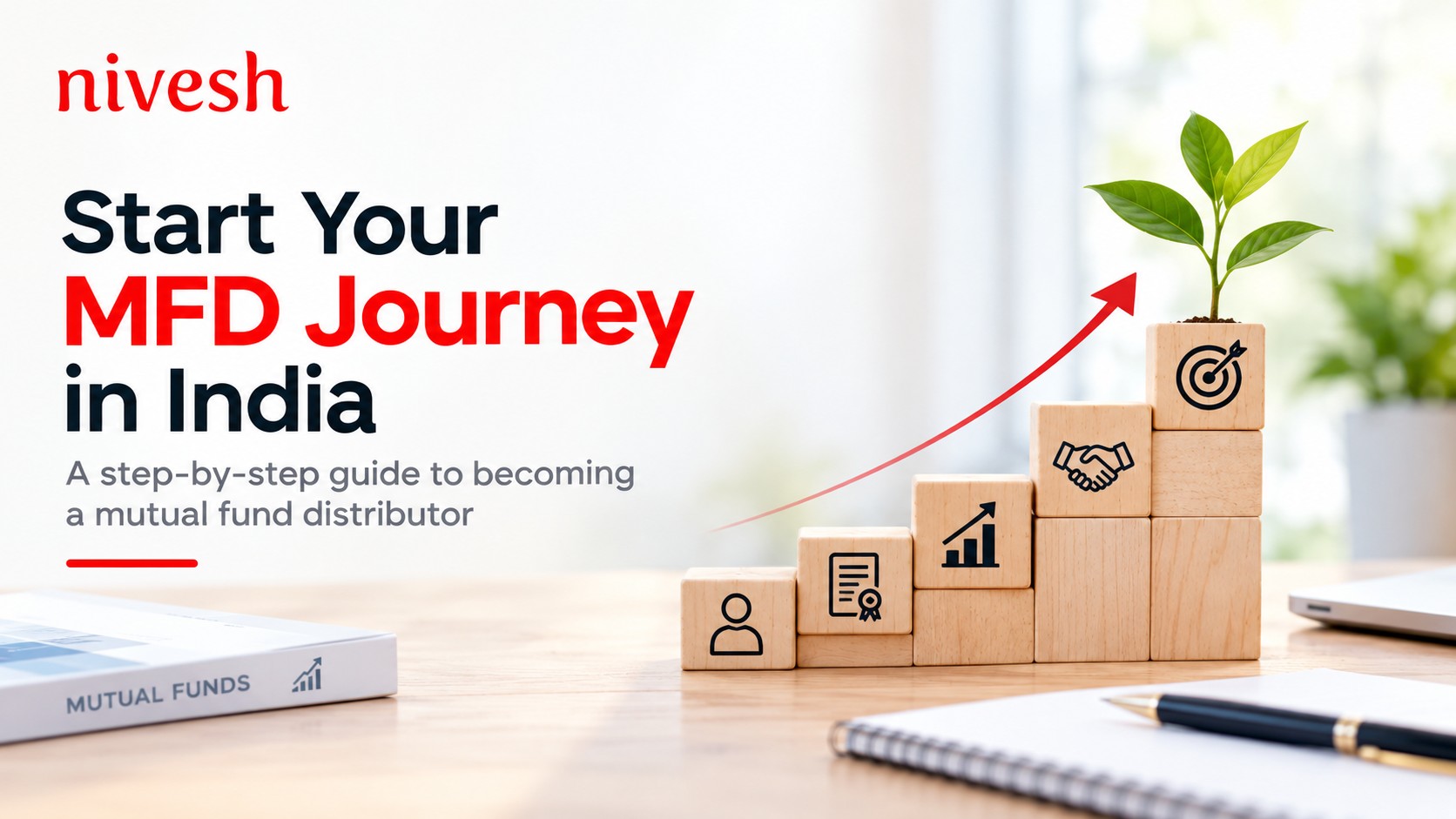
The journey can broadly be divided into three initial stages: obtaining the required certification, registering with AMFI and choosing how you want to establish your distribution setup.

Step 1: Clear the NISM Series Certification
The first formal step toward becoming a Mutual Fund Distributor is clearing the relevant NISM certification. Depending on the products you plan to distribute, you can consider NISM Series V-A or V-D.
NISM Series V-A for Mutual Funds Only
The NISM-Series-V-A: Mutual Fund Distributors Certification Examination covers mutual fund products, distribution practices, investor-related aspects and regulatory requirements relevant to mutual fund distribution.
NISM Series V-D for Mutual Funds + SIF
The NISM-Series-V-D: Mutual Fund – Specialized Investment Fund Distributors Certification Examination is a newer certification covering the distribution of both Mutual Funds and Specialised Investment Funds (SIFs).
Particular |
NISM Series V-A |
NISM Series V-D |
Applicable for |
Mutual Fund distribution |
Mutual Fund + SIF distribution |
Questions |
100 |
150 |
Duration |
2 hours |
3 hours |
Passing Score |
50% |
60% |
Negative Marking |
No |
10% |
Certificate Validity |
3 years |
3 years |
Exam Fee |
₹1,500 + applicable charges |
₹3,000 + applicable charges |
Step 2: Register With AMFI and Obtain Your ARN
After obtaining the required NISM certification, the next step is to apply for your AMFI Registration Number (ARN).
The ARN serves as your registration identifier as a Mutual Fund Distributor. AMFI's current process requires applicants to complete the prescribed registration and KYD requirements. AMFI also maintains the applicable rules and circulars governing MFD registration and ARN renewal.
Documents and Details Required
Depending on the applicant type and current AMFI requirements, you should keep the following information and documents ready:
-
PAN card
-
Aadhaar card
-
NISM certification details/certificate
-
Recent photograph
-
Address and identity details
-
Banking details, wherever required
-
KYD-related information and documents
-
Other documents or declarations prescribed as part of the current ARN registration process
It is important to check the latest AMFI requirements before submitting your application, as registration procedures can be updated from time to time.
Once your ARN is issued, you have completed the core registration stage. The next question is how you want to operate and grow your distribution business.
Step 3: Explore Your Options for Building an MFD Business
Once you have your ARN, there are two broad ways to build your distribution setup.
Option A: Empanel directly with AMCs
You can directly approach individual Asset Management Companies (AMCs) and complete their respective empanelment processes.
Each AMC may have its own requirements and procedures. Once empanelled, you can distribute the eligible schemes offered by that fund house.
Option B: Empanel With an MFD Business Platform
Instead of managing your business infrastructure independently, you can partner with an MFD-focused platform like Nivesh to simplify your day-to-day operations where MFDs can access multiple investment products from various AMCs under one platform.
Which Empanelment Approach Should You Choose?
Both approaches can help you distribute mutual funds, but the way you manage your business can differ:
-
Direct AMC empanelment: You need to complete the empanelment process separately with each AMC you want to work with.
-
MFD platform: Partnering with a platform like Nivesh can give you access to multiple products from various AMCs through a single platform.
-
Technology support: An MFD platform can provide digital tools for transactions, servicing and day-to-day business management.
-
Portfolio management: Manage client portfolios and transactions seamlessly through a single platform.
-
Additional business support: You can also get partner, marketing and operational support, helping you focus more on client relationships and AUM growth.
For MFDs looking to scale their business, partnering with MFD platform approach can help reduce operational effort while giving them more time to focus on clients, business development and AUM growth.
Step 4: Build Your MFD Business Beyond Registration
Getting your ARN is just the beginning. Building a sustainable MFD business requires growing your client base, managing portfolios efficiently, expanding product offerings and consistently working towards AUM growth.
What Do You Need to Build a Successful MFD Business?
Getting an ARN is only the beginning. Turning your registration into a sustainable business requires consistent work across multiple areas.
Build a Strong Client Base
Client acquisition is an important part of any distribution business. MFDs can build their client base through referrals, personal networks, digital outreach, local relationships and other marketing channels.
The objective is not simply to acquire investors but to develop long-term relationships with them.
Focus on AUM Growth
A sustainable MFD business is generally built over time. SIPs, additional investments and long-term client relationships can contribute to the gradual growth of AUM.
MFDs can also focus on understanding the changing needs of their existing clients and identifying relevant investment opportunities within the products they are authorised to distribute.
Provide Consistent Investor Service
Investor servicing continues after the initial transaction.
Clients may need support with transactions, KYC-related requirements, account information, portfolio tracking and other service requests.
Providing timely and consistent support can help MFDs build stronger relationships with their investors.
Use Technology to Scale
As your client base grows, managing transactions, portfolios, communication and servicing manually can become increasingly difficult. Using a digital MFD platform and mobile app can help streamline these activities in one place.
With the right technology, MFDs can manage client portfolios, transactions, investor servicing and business activities digitally, reducing manual work and making day-to-day operations more seamless. Platforms can also provide tools for client management, communication and business growth.
Partnering with an MFD-focused platform like Nivesh gives distributors access to technology and operational support while helping them manage their growing client base more efficiently.
Start your journey to a successful MFD business with Nivesh today
Getting your ARN is only the beginning. The next step is building a business that can serve more clients, manage growing AUM and deliver a seamless investor experience.
Nivesh provides a digital platform designed for Mutual Fund Distributors, bringing technology, investment products and business support together in one ecosystem. From mutual funds and SIFs to PMS, AIFs, NPS, insurance and other investment solutions, Nivesh helps MFDs manage and grow their wealth management business.
For MFDs looking to move from simply being registered to building a scalable distribution business, the right combination of technology, products and support can make the journey more structured and efficient.