Build Long Term Wealth
"Being rich is not equal to being wealthy." - Psychology of Money, Morgan Housel
Save Money
Saving money is the foundation of building long-term wealth. Many of us are not able to reach our savings goals and often our expenses exceed the budget. To start saving efficiently, write down basic accounting of how much money you make vs how much money you spend. Allocate your income for specific purposes like living expenses, savings, elimination of debt, and ‘fun’ money(you will feel motivated to make more money). After you start achieving your savings goals, take a step towards building your emergency fund to cover your expenses in case of an illness or injury or any other emergency.
Invest Your Money Wisely:
Building long-term wealth requires time, diversification, and asset allocation. You should invest at least 10% of your monthly income in long-term investments like stocks, mutual funds, ETFs, bonds, and insurance. Determine your investment horizon, financial goals (e.g., buying a house, car, education, retirement), and risk appetite.
Investing in mutual funds through a Systematic Investment Plan (SIP) helps you in disciplined investing without fearing market volatility. Asset allocation across different asset classes like equity, debt, and gold, which are available within mutual funds, is important for building long-term wealth.
The following chart depicts value of building wealth through systematic investments over a long period of time:
Wealth Build-Up with Consistent Investment
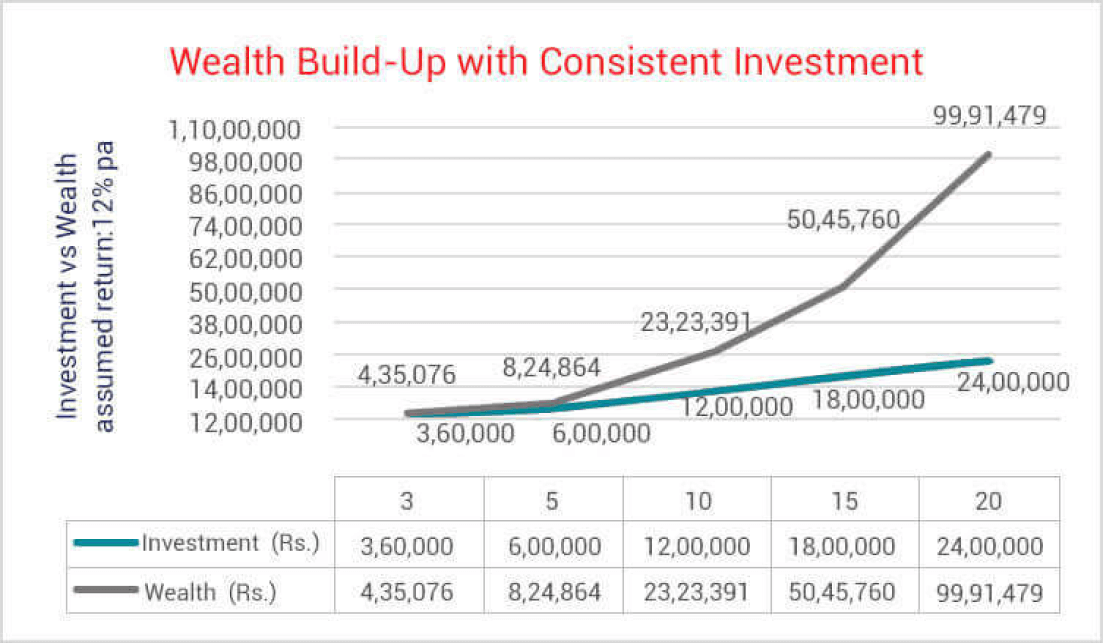
| Year | Investment (Rs.) | Wealth (Rs.) |
|---|---|---|
| 3 Years | 3,60,000 | 4,35,076 |
| 5 Years | 6,00,000 | 8,24,864 |
| 10 Years | 12,00,000 | 23,23,391 |
| 15 Years | 18,00,000 | 50,45,760 |
| 20 Years | 24,00,000 | 99,91,479 |
A monthly investment of Rs. 10,000 over a 20 years period can yield about Rs. 1 crore at an assumed return of 12% pa, while the total investment will be Rs. 24 lakh.
Starting early with your investments is crucial. The power of compounding helps grow your wealth from small, consistent amounts over time, making it easier to achieve your long-term financial goals.
Frequently Asked Questions (FAQs)
Loading FAQs...