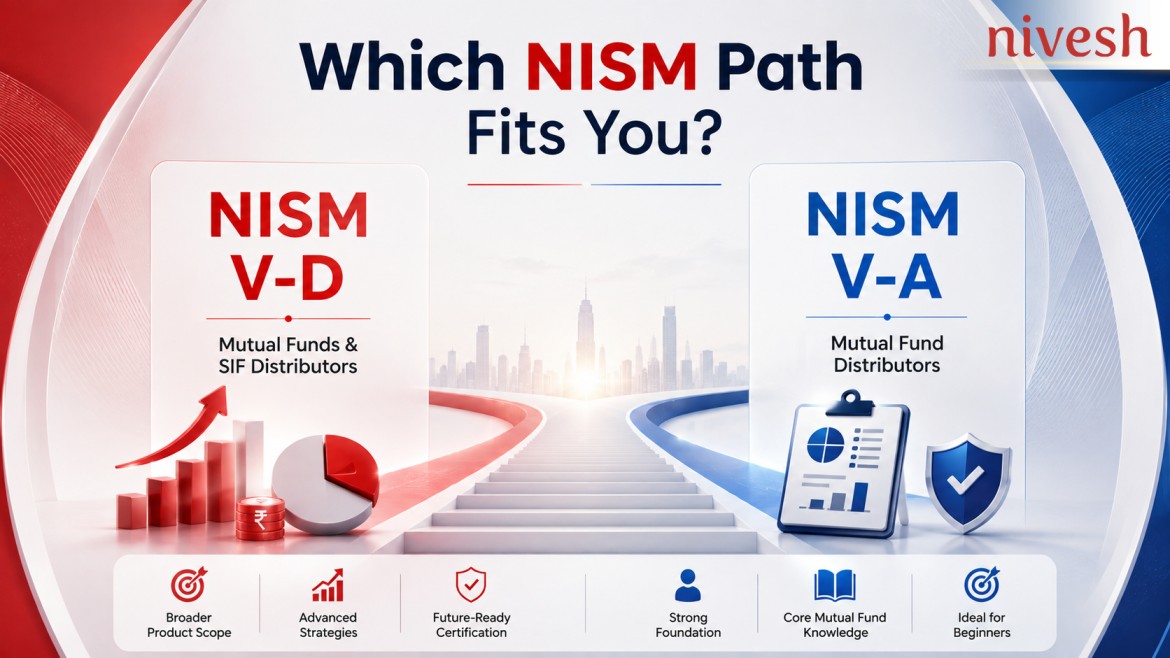
NISM Series V-A vs NISM Series V-D: Which Certification You Should Choose?
The investment industry is evolving, and so are the certification requirements for Mutual Fund Distributors (MFDs). With the introduction of NISM Series V-D, many aspiring and existing distributors are asking the same question:
Should I choose NISM V-A or NISM V-D?
While both certifications are designed for professionals in the mutual fund industry, they serve different purposes. Understanding the difference is important before deciding which exam to take.
In this guide, we'll compare NISM Series V-A and NISM Series V-D based on their purpose, eligibility, exam pattern, syllabus, and career opportunities, helping you make an informed decision.
What is NISM Series V-A?
NISM Series V-A: Mutual Fund Distributors Certification Examination is the mandatory certification for individuals who want to become Mutual Fund Distributors in India.
The certification provides the knowledge required to understand mutual fund products, regulations, investor services, taxation, and ethical distribution practices. After passing the exam, candidates can apply for an AMFI Registration Number (ARN) and begin distributing mutual funds.
This certification is ideal for:
-
Aspiring Mutual Fund Distributors
-
Financial Advisors
-
Wealth Managers
-
Relationship Managers
-
Anyone planning to build a career in mutual fund distribution
What is NISM Series V-D?
NISM Series V-D: Mutual Fund and Specialized Investment Fund (SIF) Distributors Certification Examination is a new certification introduced by NISM following SEBI's revised certification framework.
Unlike V-A, this certification covers Mutual Funds as well as derivatives-related concepts relevant to Specialized Investment Funds (SIFs). It is designed for distributors who want to expand their offerings beyond traditional mutual funds and cater to investors looking for more advanced, strategy-driven investment solutions – including funds that use equity and interest rate derivatives.
If you plan to distribute SIFs along with mutual funds, NISM V-D is the certification to consider.
NISM V-A vs NISM V-D: Key Differences
|
Feature |
NISM Series V-A |
NISM Series V-D |
|
Purpose |
Distribution of Mutual Funds |
Distribution of Mutual Funds and SIFs |
|
Suitable For |
Beginners and Mutual Fund Distributors |
Distributors planning to offer Mutual Funds and SIFs |
|
Mutual Fund Distribution |
Yes |
Yes |
|
SIF Distribution |
No |
Yes |
|
Number of Modules |
1 |
3 |
|
Exam Duration |
2 Hours |
3 Hours |
|
Number of Questions |
100 |
150 |
|
Passing Marks |
50% |
60% |
|
Negative Marking |
No |
10% negative marking for incorrect answers |
|
Exam Fee |
₹1,500 + GST |
₹3,000 + applicable charges |
Purpose of the NISM Certification
The biggest difference between the two certifications lies in what they qualify you to distribute.
NISM V-A focuses entirely on mutual fund distribution. It is suitable for professionals whose business revolves around traditional mutual fund products.
NISM V-D, on the other hand, prepares distributors to offer both mutual funds and Specialized Investment Funds. Since SIFs are designed for investors seeking more sophisticated, derivative-linked investment strategies, the certification covers additional concepts – including equity derivatives and interest rate derivatives that go well beyond the scope of V-A.
Exam Pattern of NISM Certification
The exam structure also differs significantly.
NISM V-A is a relatively shorter examination with 100 questions to be completed in two hours. There is no negative marking, making it a good choice for beginners entering the industry.
NISM V-D is more comprehensive. Candidates must answer 150 questions within three hours and should be mindful of the 10% negative marking for incorrect answers. The passing requirement is also higher at 60%, reflecting the advanced nature of the certification.
Syllabus Comparison
Although both certifications cover the fundamentals of mutual funds, their scope differs considerably. NISM V-A is built around a single, focused module, while NISM V-D is spread across three modules that bring in equity and interest rate derivatives alongside core mutual fund knowledge.
NISM V-A Syllabus
The NISM V-A syllabus broadly covers:
-
Investment Landscape
-
Concept and Role of Mutual Fund
-
Legal Structure of Mutual Funds in India
-
Legal and Regulatory Framework
-
Scheme Related Information
-
Fund Distribution and Channel Management Practices
-
Net Asset Value, Total Expense Ratio and Pricing of Units
-
Taxation
-
Investor Services
-
Risk, Return and Performance of Funds
-
Mutual Fund Scheme Performance
-
Mutual Fund Scheme Selection
NISM V-D Syllabus
NISM V-D expands significantly on V-A by organizing its content into three distinct modules.
Module 1: Mutual Fund Distributors
-
Investment Landscape
-
Concept and Role of a Mutual Fund
-
Legal Structure of Mutual Funds in India
-
Legal and Regulatory Framework
-
Scheme Related Information
-
Fund Distribution and Channel Management Practices
-
Net Asset Value, Total Expense Ratio and Pricing of Units
-
Taxation
-
Investor Services
-
Risk, Return and Performance of Funds
-
Mutual Fund Scheme Performance
-
Mutual Fund Scheme Selection
Module 2: Equity Derivatives
-
Basics of Derivatives
-
Understanding Index
-
Introduction to Equity Futures and Forwards
-
Introduction to Equity Options
-
Strategies Using Equity Futures and Equity Options
Module 3: Interest Rate Derivatives
-
Introduction to Interest Rate, Interest Rate Instruments and Fixed Income Market
-
Interest Rate Derivatives
-
Exchange Traded Interest Rate Futures
-
Exchange Traded Interest Rate Options
-
Strategies Using Exchange Traded Interest Rate Futures and Options
As you can see, Module 1 of V-D mirrors the entire V-A syllabus almost exactly so, if you've already prepared for or cleared V-A, you have a strong head start on V-D. Modules 2 and 3, however, are entirely new territory, requiring a solid grasp of derivatives, futures, options, and fixed income instruments - concepts that go far beyond traditional mutual fund distribution.
Which Certification Should You Choose?
Your choice depends on your career goals.
Choose NISM V-A if:
-
You are starting your career as a Mutual Fund Distributor.
-
You only plan to distribute mutual funds.
-
You want to build a strong foundation before exploring advanced products.
-
You'd prefer a shorter exam with no negative marking as your entry point into the industry.
Choose NISM V-D if:
-
You want to distribute both Mutual Funds and SIFs.
-
You want to future-proof your advisory business.
-
You are looking to expand your product offerings for high-value investors.
-
You are comfortable learning equity and interest rate derivatives alongside mutual fund fundamentals.
-
You are prepared for a longer, more rigorous exam with negative marking.
Final Thoughts on NISM V-D Vs NISM V-A
Both NISM Series V-A and NISM Series V-D play an important role in the financial services industry. Neither certification is "better" than the other– the right choice depends on the products you plan to offer and the clients you want to serve.
If you are just entering the mutual fund industry, NISM V-A is an excellent starting point. Its single-module structure covers the fundamentals and enables you to begin your journey as a Mutual Fund Distributor without the added complexity of derivatives.
If your goal is to stay ahead of industry changes and offer a wider range of investment solutions, NISM V-D is the more future-ready option. Its three-module structure – spanning mutual fund distribution, equity derivatives, and interest rate derivatives – equips you with the knowledge to distribute both Mutual Funds and Specialized Investment Funds, helping you meet the evolving needs of investors.
As the investment landscape continues to evolve, choosing the right certification today can help build a stronger advisory practice for tomorrow.