Indian mutual fund industry has shown immense growth, with assets around ₹87.09 lakh crore up to Sept 2026. With such growth, 61.4 crore people invest in mutual funds, whereas there are nearly 2 million mutual fund distributors in the market. Such a gap is providing many opportunities for those who wish to start a career in mutual fund distribution and are exploring steps to become mutual fund distributor.
If you are an insurance agent, CA, financial advisor, or an entrepreneur looking to increase your business, being a mutual fund distributor can be the best choice. In addition to your existing clientele, you can offer more financial services, build long-term relationships, and earn regular income through trail commission without investing in mutual funds. But how do you get started? Let’s understand the process, eligibility criteria, and the steps to become a mutual fund distributor in India.
Eligibility Criteria for Becoming a Mutual Fund Distributor in India
Individuals who want to become mutual fund distributor in India need to fulfil specific educational, certificate, and registration criteria as prescribed by the respective authorities. For an individual seeking steps to become a mutual fund distributor, the following are some of the basic criteria that need to be fulfilled:
-
The age needs to be at least 18 years old.
-
The basic education requirement is to pass the 10+2 examination.
-
Pass the NISM-Series-V-A, a mutual fund distributor certification examination.
-
Register with AMFI and get an ARN number.
-
Perform KYC formalities and furnish identification proof.
-
Register under GST if your turnover is above a certain limit.
-
Need to have a bank account and infrastructure for conducting business.
Steps to Become a Mutual Fund Distributor in India
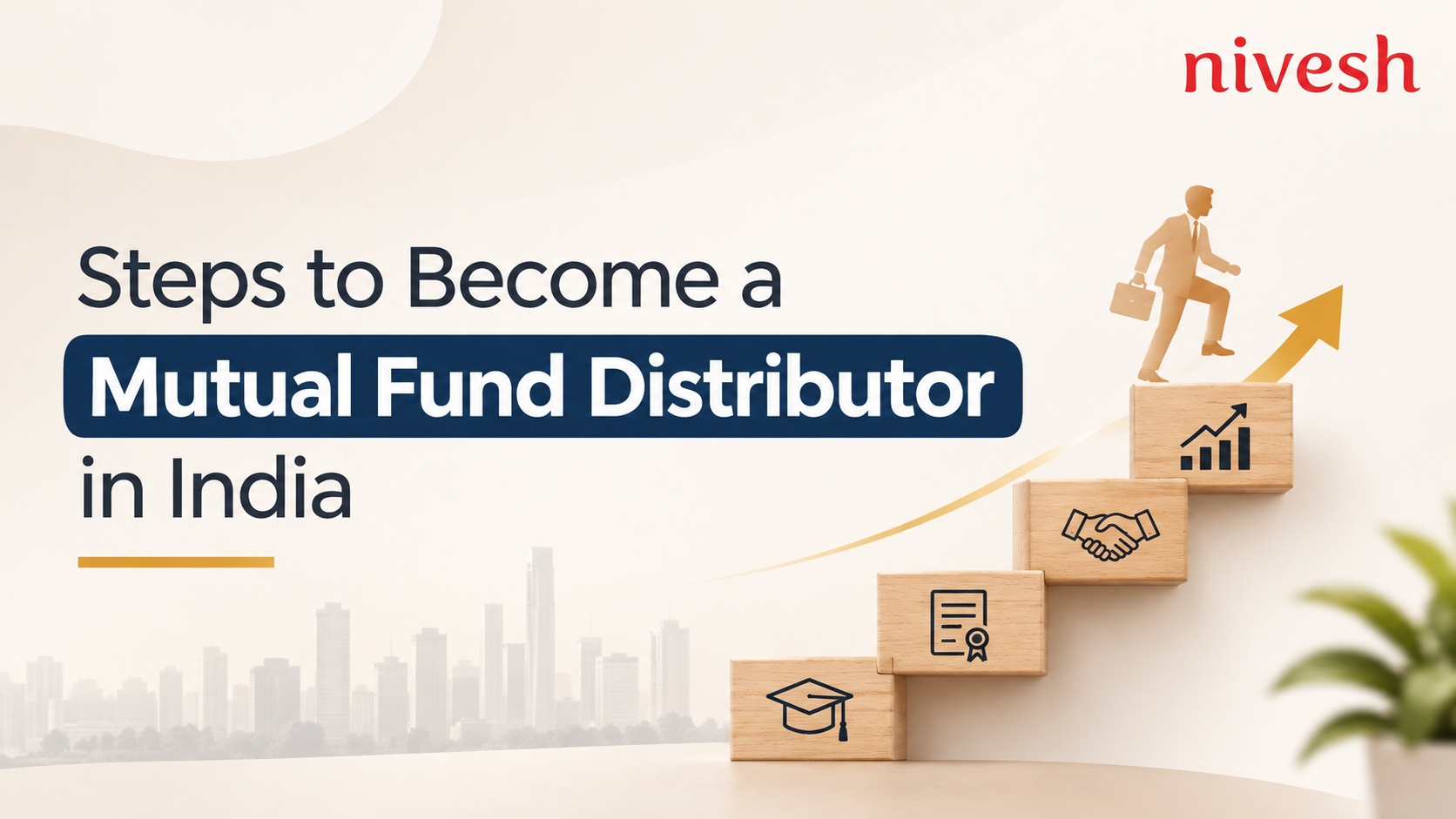
Follow these steps to become a mutual fund distributor and understand the process from certification to registration:
Step 1: Pass the NISM Series V-A Exam
First, you need to clear the NISM VA Mutual Fund Distributors Certification Examination, which is conducted by the National Institute of Securities Markets (NISM). This mutual fund distributor exam tests your understanding of different elements of mutual funds, such as concepts, kinds of schemes, risks and rewards, taxation, and regulations, among other things. Clearing the exam will ensure that you have enough knowledge about mutual funds and are able to answer all client queries with confidence.
Key NISM V-A Examination Details
-
Fee: ₹1,500
-
Format: 100 questions of 1 mark each
-
Time: 2 hours
-
Passing mark: 50%, with no negative marking
-
Validity: 3 years
Step 2: Complete Your “Know Your Distributor” Process
After passing the examination, the next stage in the steps to become mutual fund distributor is to complete your KYD process. KYD is an identification and verification process used by AMFI to verify a distributor's identity and credibility. It promotes transparency and ensures that distributors meet their necessary registration requirements. From 1 October 2024, the process runs using Aadhaar and PAN details or through a KYC Registration agency. Physical biometric submission is no longer required, and the whole process is completed online through the CAMS or KFintech portals.
Step 3: Apply for AMFI Registration Number (ARN)
Applying for an ARN is one of the next steps to become mutual fund distributor. After the KYD process is completed, you need to apply for an ARN. The unique identifier will be proof of your registration as a mutual fund distributor, and it will enable you to conduct distributor activities under that framework. Fill in the application form along with other necessary documents and pay the fee for registration. Your application will be processed by CAMS, and you can fill out your application form from the AMFI ARN Registration Portal.
Step 4: Empanel With an Asset Management Company (AMC) or a Distribution Platform
Receiving your ARN brings you closer to steps to become a mutual fund distributor. Next, you need to empanel with AMCs or join a mutual fund distribution platform. Being empanelled gives you access to mutual fund schemes and the infrastructure involved in distributing them. When choosing a platform, look for features such as access to multiple AMCs, transaction facility, portfolio reporting and effective customer care solutions. The right technology application like Nivesh platfrom can make your day-to-day operations simpler as your business grows.
Step 5: Set Up Your Distribution Business
Once you complete the steps to become mutual fund distributor, it is time to build your business. Start by identifying your ideal client base, developing strong referral networks and establishing a strong system to attract new clients. Invest in technology which can simplify financial transactions, enable easy tracking of investments and portfolio services and offer excellent customer care services. As your AUM grows, effective systems and regular communication will help you strengthen client relationships and grow your business.
Total Cost to Become an MFD
Knowing the initial cost to become a mutual fund distributor is equally important as following the steps to become mutual fund distributor. Starting an MFD business requires an investment that depends on your business structure, registration needs, and operational setup. The entry cost of becoming an individual mutual fund distributor is as follows:
|
Cost component |
Applicable fees |
|
NISM Series V-A exam |
₹1,500 + gateway charges |
|
ARN registration (individual or proprietorship) |
₹3,000 + 18% GST = ₹3,540 |
|
EUIN for an individual ARN holder |
Free with ARN |
|
Total cost to start |
₹5,040 + gateway charges |
The above fee is for individual applicants. Employees of distribution firms must pay Rs.1,500 + GST to obtain their own EUIN.
How Mutual Fund Distributors Earn
Mutual fund distributors primarily earn through trail commissions paid by AMCs. The commission rate is calculated as a percentage of assets under management in regular mutual fund schemes. As long as clients’ investments are active, distributors may earn the trail commission. This indicates that MF distributor income relies heavily on total AUM rather than the number of transactions completed. The longer the clients remain invested, the greater the potential to earn recurring commissions. Understanding these earnings is also important when learning the steps to become a mutual fund distributor. Here are a few ways to increase your income:
-
Increase your SIP corpus: Encourage clients to make consistent SIP investments to expand your overall AUM.
-
Retain existing clients: Keep in touch with your current clients, particularly when there are fluctuations in the market.
-
Conduct regular portfolio review sessions: Keep your investors updated about their investments and help them to make well-informed investment decisions.
-
Build a strong referral network: Satisfied clients can recommend your financial services to other potential customers. This can contribute to growing your client base as an MF distributor.
Conclusion
Starting a mutual fund distribution business involves several important steps, including NISM certification, KYC verification, ARN registration and AMC empanelment. But understanding the steps to become mutual fund distributor is just the starting point. Building a successful distribution business requires effective technology, healthy client relationships, and sustained efforts to grow AUM. With effective planning, you can build a viable and sustainable mutual fund distribution business.
FAQs
1. Is MFD business profitable?
Yes, an MFD business can generate profits through recurring trail commissions, AUM growth, client retention and long-term business expansion.
2. Who are the top three MFDs in India?
Based on FY 2026 AUM rankings, the top three MFDs are SBI Mutual Fund, ICICI Prudential Mutual Fund, and HDFC Mutual Fund.
3. Can an MFD provide financial planning services?
An MFD cannot offer investment advisory or financial planning on its own unless registered with SEBI as an Investment Adviser.
4. How much commission does an MFD earn?
MFDs earn trail commission, which depend on the mutual fund scheme, AMC and applicable commission structure.
5. Is an MFD business profitable in the long term?
Yes, with steady client acquisition, strong relationships, increasing AUM, and recurring trail commissions, running an MFD business can generate substantial long-term income.